Sunday, February 22, 2009

O Furtune - smiled on me

To be able to experience, live, Haydn's Oboe Concerto and Orff's Carmina burana in one evening was fortunate and exhilarating.

Haydn's Oboe Concerto is one of my favorite all time pieces. Something about it sends chills down my spine. I first heard it in the early 1990's on WQED-FM 89.3 at my work place, at lunch. A friend, after hearing me exclaim that it was a fantastic composition, told me to call the DJ and ask what it was, so I did. Paul Johnston, the DJ at the time, was glad to tell me it was Haydn's Oboe Concerto. So ever since then I've purchased a few versions, and have been waiting for the PSO to bring it to Pittsburgh. Well tonight I was not disappointed, the PSO premiere performance was just as great as I could have expected, and Cynthia Koledo DeAlmeida did a spectacular job on the Oboe.

The Carmina burana likewise did not disappoint, the live performance was so much more powerful than any prerecorded version. And what a surprise, all those lovely movements in between the opening and closing O Fortuna. This, therefore, I would consider as my first hearing of this complete piece, even though I did recognize one other movement in between. The complexion of the O Fortuna movement, and all the other movements, to my ears, and eyes, seemed someone different. Not knowing Latin, I did not know what they were singing, not a problem as the singing itself sounded melodious and understanding was not a requirement for enjoyment. The 'new' musicgreat minds think alike showed many light, airy and beautiful parts at first, much different than the opening, and not what I expected. Then when the solo singers began to sing what to me seemed to be a comic opera, beautifully performed, and some humorous body movements causing audience laughter, I was again surprised, pleasantly.
What is this piece? I kept wondering, it has so many elements that I find difficult to put together. All of the movements were lovely to hear, but I was in a quandary. The culmination of what seemed to be a love affair ensued, but I was not sure, and it seemed to come together at the end and a reprise of the O Fortuna concluded the cantata. Later, at home, I read the English translation of the O Fortuna (below). This seemed to indicate that perhaps this is a tragedy, and not a comedy, so again I'm confused. I see I've got some reading to do to bring myself up to speed. But the lingering impression was that the music was fantastic, and all the players of the Mendelssohn Choir of Pittsburgh, the soloists and the Pittsburgh Symphony Orchestra conducted by Manfred Honeck, did a fantastic job. I can't wait to experience this again, next time I'll have context.

English translation of "O Fortuna," a poem from Carmina Burana

"O Fortune,
like the moon
Stands constantly changing,
ever waxing
but waning;
hateful life
now oppresses
and then soothes
as fancy takes it;
poverty
and power
it melts them like ice.

Fate - monstrous
and empty,
you whirling wheel,
stand malevolent,
well-being is vain
and always fades to nothing,
shadowed
and veiled
you plague me too;
now through the game
I bring my bare back
to your villainy.

Fate, in health
and virtue,
is against me
driven on
and weighted down,
always enslaved.
So at this hour
without delay
pluck the vibrating strings;
since Fate
strikes down the strong man,
everyone weep with me!"

Friday, February 20, 2009

O Fortuna as a creative spark

What exactly is Carmina Burana, the O Fortuna music by Carl Orff? balancedI frankly don't know for sure. I'm writing my thoughts on what it means to me. First, I've mostly heard the approximately 2 and a half minute segment of the O Fortuna, the most famous movement from Orff's cantata. Who hasn't heard this? It's so famous, that I suspect it is as recognizable as just about any other composition. I remember it was used in a television advertisement for the Marine Corps and one for the National Guard.

I also remember it was used in many movies, the one I remember most is in the movie 'Excalibur', 1981. Others include 'Hunt for Red October', 1990, 'The Doors', 1991, and Lord of the Rings.

But that's ultimately not what it means to me. To me it isn't a thought of a collective force, but rather an individual creative spark. A song of an individual who is perhaps sought by the collective, or shunned, but operates independently, on his or her own, using their own internal force, their own power of thought, reason and sense of right and wrong, in a quest to do what's right for themselves and for all, to reject the unholy or ungodly, to embrace the adventure, to endure the torment, the rejection of the collectivist or societal norms when those norms are wrong, to surmount any odds, and to do it all with a great zest, zeal and humor presented forward and outwards, a certain unalienable smile and jovial spirit, to quench the thirst for the adventurer himself, as a kind of pirate with a gentleman's charm.


Indeed this music is compelling, the kind that drives man to passion, to movement, to action. It distinctly has that effect on me. To achieve, to write, to invent, any creative individualist act that I can think of, to type faster, to produce, without hesitation, something, I know not what, and yet it is there. But it is too short in that form, I'm awaiting the rest of it, I'm wanting more. I could listen to that segment, part of that O Fortuna movement again, and I will. But I will hear the whole cantata performed by the Pittsburgh Symphony on Saturday night, and I will write more.

I've found out since that:

http://en.wikipedia.org/wiki/Carmina_burana
From the 11th-13th Century, Carmina Burana is a collection of love and vagabond songs.
Carmina Burana, also known as the Burana Codex, is a manuscript collection found in 1803 in the Bavarian monastery of Benediktbeuern and now housed in the Bayerische Staatsbibliothek in Munich. The 119 leaves of the original collection contain 228 poems compiled by three different scribes.
Fortuna is the goddess of fortune in Roman Mythology.


http://en.wikipedia.org/wiki/Carmina_Burana_(Orff)
Carmina Burana is a scenic cantata composed by Carl Orff between 1935 and 1936. It is based on 24 of the poems found in the medieval collection Carmina Burana. Its full Latin title is Carmina Burana: Cantiones profanae cantoribus et choris cantandae comitantibus instrumentis atque imaginibus magicis ("Songs of Beuern: Secular songs for singers and choruses to be sung together with instruments and magic images.") Carmina Burana is part of Trionfi, the musical triptych that also includes the cantata Catulli Carmina and Trionfo di Afrodite. The best-known movement is "O Fortuna" that opens and closes the piece.

Saturday, February 7, 2009

Metronomic candor

The beauty of Beethoven's Symphony number 8 has driven me to poetry once more, based on words I wrote during the wonderful performance by the Pittsburgh Symphony Orchestra under the baton (literally) of Rafael Frühbeck de Burgos. I heard marvelous synchronicity and superlative metronomic fluidity. The maestro was wonderful with his marvelous conducting, the left hand was expressive and the right hand led with the baton, and there were plenty of smiles in the orchestra to go around...
Metronomic candor - Beethoven Symphony No. 8

Gorgeous serendipity, landed squarely on my nose
No lack of hesitation, dare rob me of my prose
Speaking speech in volume, pitched above three rows
Luck she barely knew me, and nimble on her toes

Born with trepidation, and furrows on her brow
A subtle time and mellow rhyme, and now's when I avow
Overture preamble, pioneering lead somehow
Further salutation, hello goodbye and ciao

What rapid introspection, as during tranquil lull
Was thought and then was lost upon, and glance would soon befall
Approaching gentle movement, commence and dart away
Lunge full bore, sawing bow and sweeping sooth foray

Steeped to incredulity, behind inquiring glance
Thread simple hesitation, woven as a dance
Morphing other voices, and rhythm to enhance
Stretched around my temple, unlikely as romance

Extend seesaw return chutzpa
Winding up reverb
Unleash what's raw and look voila
Adoration cannot curb

Start again, reprise and yet, consider slower still
Metronomic candor, ascending toward yon hill
Drowning with your grandeur, grasping for a thrill
Bass and sound revolve around, strings they do instill

Impetuous dampened softness, rich with full contour
Sweet and slender tremor, ascend with bass once more
Burst horns upon my consciousness, alert to hear the score
Prepare one heart for apex, last passion to endure

Metronomic candor

Tuesday, February 3, 2009

Trio Orchestration

February 02, 2009

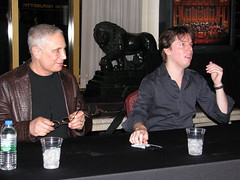
I really enjoyed the concert, and the Trio was new for me, and quite beautiful. The piano concerto was sublime (photo below with pianist Orion Weiss during the pre-concert chat: he was marvelous in the Grieg piano concerto). A few comments from Maestro Tortelier on his orchestration of the Ravel Trio. This is a very shortened list of the remarks that elicited a response from the audience, laughter or applause. He was quite entertaining during his introduction of the piece. Read the description for context.

  • .. in the Mother Goose - Alright, you still with me?
  • .. it's the same music anyway - I hope you recognize it.
  • .. game of tunes / two sides of a coin - witty / subtle and waltzy
  • .. scherzo or chorale: a trio of trios
  • .. we start with the strings, are you ready for sensual horns, sexy trumpets
  • .. a slow Passacaille: starting with only double basses, builds to a climax and all the way down to the bottom
  • .. (describing arches with joyful impetuosity) one arch is enough
  • .. Are you interested in the climax? -- we make more noise
  • .. (based on Ravel's notes) not sounding trumpety enough, I gave this part to the trumpets

I also very much enjoyed the first piece, I wrote this while listening...
My poem based on Jean Sibelius: The Swan of Tuonela

You were a dream to me, I could not conceive
heighten tension sliding below
ebbing higher gently swayed as in a breeze
softly enunciating naivety

Flutter by, but don't wave
don't see me below your soaring wing
perceive your world, but not my black watery depths
awakening beyond as light permeates mist

Full and rich depths surround
as grand aura fills my sound
your lone voice observes alone
higher still - would we soar at the same height?

Yet not together
Take a bow and smile

What a treat! Montero at the PSO

January 24, 2009

Tonight, I enjoyed so many facets of the concert at the PSO, its hard to do them all justice. The works performed were all wonderful, and some were new to me, including Barber Symphony No. 1 and Mendelssohn Symphony No. 5 (actually he composed this symphony as the second in the sequence, but it was labeled as 5), both wonderful works in their own right, yet not played very often on the classical stations.

It was Gabriela Montero who stole the show. Her playing in the Rhapsody in Blue was a unique experience. The jazz and tempo were all her own. But the real treat was right after the Gershwin composition. Ms. Montero asked the audience what kind of improvisation she could do, what particular song, perhaps something from Pittsburgh, she could take and turn into an impromptu rendition for just this occasion. No need to wonder, the mass of the audience chanted 'Here we go', yes, the Steeler song (if you are not from Pittsburgh, realize that the Pittsburgh Steelers are going to the Super bowl next week). And there she went, playing a magnificent composition with the Steeler chant interwoven beautifully, some classical Baroque, and finally ending with a rhythmic mamba. The audience irrupted with the most sudden applause I have ever heard. I was a sight to behold, a sound never to be forgotten.

After intermission we were again surprised: Ms. Montero and three other PSO musicians formed a quartet and performed John Williams' "Air and Simple Gifts" which was originally played a few days ago at the presidential inauguration. It was a beautiful piece, obviously based on a theme of Copland.

Afterward, there was a post concert chat with Jim Cunningham and Ms. Montero.

Question: "What is your favorite piece to play"

Montero: "There are many, right now I'm really into concertos. I'm playing Rachmaninoff 3, that's one of my all time favorite pieces to play. I'm also playing Brahms No. 1 in Vienna, which I absolutely adore. I'm very fond of Brahms, Schumann, Bach, Beethoven, Rachmaninoff. Rachmaninoff I die, it's very romantic."

Nixon in China and Doctor Atomic at the PSO

January 17, 2009

The music I heard last night at the Pittsburgh Symphony, composed by John Adams, had two different complexions. Nixon in China, an opera with complete symphony and six fantastic voices, was a wonderfully melodic composition which, based on the music alone, was a completely beautiful artistic composition that I found quite pleasing. It was music that I would like to hear again. My only disappointment was with some of the words, but my mind only perceived a few of those, I'm one of those right brain types that only hears the music. Somehow, the words I did hear startled me with their political dissonance, and I chose instead to concentrate on the wonderful score. I remember the idea of Nixon visiting Red China as a wonderful way to open people's minds to the fact that worlds can be brought together.

The second composition played by the PSO and written and conducted by Mr. Adams was his Doctor Atomic Symphony. It began rather stark, with some musical dissonance, but what do you expect, it is supposed to represent the bomb. It went on to some very nice music throughout. At one point near the end there was a very sad and melodic movement which was simply beautiful, a very moving piece of music. Again I found myself wishing to hear this again. It was the kind of music that might compel one to write poetry. If I could hear it again, I think I would

Messiah, by Handel

December 14, 2008

inspiration My concert going experience Friday night was rather atypical. I went by myself. Other than the "Hallelujah" chorus, I had never heard any other parts of Handel's Messiah before. It was different, in several ways, than any classical concert I have attended. The orchestra was sparse, mostly strings, a few piccolos, a bassoon, later a few trumpets, and the keyboard player ping-ponging his way back and forth between the harpsichord and the organ. The choir was smaller than other occasions, but 43 was still a good size and sounded great. I really liked listening to that bassoon, on this occasion it was easy to discern.

Somehow I expected this composition to be more completely filled with chorus. I did enjoy the chorus and solo singers immensely, but I didn't quite expect so much of the traditional classical parts of the composition, the beautiful baroque orchestral music. These parts would really be interesting if put together in a form without the chorus, but then that wouldn't be the point.

I couldn't help but notice the audience around me. One fellow in particular had what appeared to be the complete score, faded yellow and a bit frayed. He seemed to be overjoyed to be there, and often showed the score to his friend beside him. He followed along with the music, mostly reading the score rather than watching the stage below. I was enthralled with his enthusiasm, it was contagious, and I couldn't help but frequently follow his actions. After a while I figured he must be a music director himself, perhaps of a local college or high school, and he was here to listen, observe, compare and somehow gather together his own impressions of how he would direct his own performance based on the show we were all enjoying.

There were others around me who were singing along at parts, especially the Hallelujah Chorus, even though the sing along wasn't this night. I believe the program was switched. Originally there was to be an audience sing-along on Friday evening, but it had been switched to Saturday. When they announced that at the beginning, some moaned and groaned, others laughed and seemed relieved.

I thoroughly enjoyed this experience, I can't wait to go back next year.

I wrote this description while watching "It's a Wonderful Life" on TV. At the end, when he is glad to live again, George Bailey, is hugging his kids and says "Hallelujah"! Now there's a sentiment with which I can thoroughly concur. "Every time a bell rings, an angel gets his wings"

A page of George Frideric Handel’s autograph draft score of Messiah, 1741.

Beethoven Piano Co. No. 4

November 25, 2008

My impressions of the Beethoven Piano Co. No. 4, performed last weekend by Garrick Ohlsson and the Pittsburgh Symphony Orchestra, conducted by Manfred Honeck: I was pleased with the performance, by Ohlsson and all of the members of the PSO. I was impressed by Honeck's mannerisms. I can't quite describe them yet, but they have a certain style, and I will try to put my finger on it in later, but to note: when he stands straight and tall with baton held high, expect the orchestra to respond in kind with a wonderfully explosive musical expression. Honeck comes across as humble in person when speaking, but his real expressions come when he is conducting.

The first movement seemed to contain some parts or additional phrases I've not heard before in the many times I've listened to prerecorded versions of this concerto. Is this my imagination?

The second movement was very moving. The fullness of the strings and the orchestra immediately brought the kind of force to my ears which never fails to impress. Often, the soft piano was interleaving with the orchestra like a gentle stream flowing through a mountain pass.

In the program notes, I read that this particular concerto was full of surprises for its time. Beethoven was a creative individualist -- just the quality I like; an artist that is anxious to "break the mold at every opportunity," how refreshing!. The beginning of the concerto forged a change in style. One thing mentioned was that our beloved composer changed the 'key' from the first few beginning phrases of the piano, to the entry of the orchestra, and that that represented the kind of change that was readily noticed by the first to listen to this concerto, Beethoven's early audience.

Here is my dilemma. I have very little training in music theory. I do know where each note is on a keyboard, and can readily play compositions with my right hand only, but the notion of a 'key' has somehow escaped my understanding for quite a long time. For a music lover like myself, it wasn't necessary for my enjoyment. Out of curiosity, I picked up a 'dummies' guide to music theory. I read through the entire description of keys and notions of major and minor. My first thought was that perhaps this is a notion which makes it easier for musicians to play their instruments. Just like computer can interpret instructions, the musician can interpret the notes, with the context being the 'key'. Context is a useful thing for any profession.

Key seemed to also denote the actual sets of tones of the set of notes being described. I must hand it to musicians, I find the whole notation and concepts quite difficult to grasp. Being originally an electrical engineer, I do know a little about frequencies and harmonics. I think the notions represented by 'key' could just as easily been represented by mathematical concepts related to the frequency of each note, and the relationships they all hold with respect to each other.

My contention is that I don't necessarily need to know much about 'keys' to understand and enjoy music. None of us in the audience need to know these concepts. I am sure there are quite a few out there that are conversant in this music theory, but I am not addressing them, there are likely more who do not. I am not turned off when I read the kind of description related in the program notes, I accept them as an 'extra' bit of biographical context to the music we are about to hear. But my take on the music is going to always be how it relates to my ears and mind. And of course being a live performance I get to see the performance as well.

So when I read that the 'key' change was interpreted by early listeners as 'really wrong' I am curious. Why? -- because I didn't detect a 'key' change at all. I went back to a recording I have on CD and listened again to the opening over and over. I tried to direct my mind to detect this key change that was described. But I cannot. I don't hear it. I think it is because the change in 'key' is an absolute change in the base frequency. Yet my mind is tuned to relative notes. I hear the exact sequence of notes being played because, relative to each other, they are equal algebraic multiples away from each other -- sort of my own musical theory of relativity. I don't necessarily hear the absolute frequencies, but the relationships of the sets of notes to one another in a particular phrase. If the same phrase is repeated in different key, then to me, it was the same phrase, sounding just a good as the original.

I wonder if these 'original' listeners to Beethoven, especially those who were critics or music reviewers some 200 years ago, are perhaps a minority. I wonder if perhaps there were many others, who like me, simply sat back and enjoyed the music. But when they read the press, unlike me, they were told that the aforementioned 'key' change was 'really wrong' or 'simply wrong' and did not conform to the typical opening of a concerto. So, like people of today, perhaps they let that information bias or distort their view. And forever more, we will believe that the 'consensus' of that time was that Beethoven was different, and therefore a bit 'mad'.

That's the kind of madness I call genius, I wish I had a bit of it myself.

Impressions of the Bruckner Symphony No. 4

November 22, 2008

The second movement of the Bruckner was my favorite. You hear the raw power of the Pittsburgh Symphony Orchestra strings, each member acting in unison, pushing the romantic uplifting theme, reverberating deep into my body and soul. In person it is worlds apart from a recording. The violas get to shine. As they play with alacrity and potency, their theme is counter-posed by the rest of the strings preforming pizzicato. Interesting how only 12 viola players can put forth so much volume, when compared to perhaps 26 violins and the rest of the strings, not to mention the obvious fact that violas are facing away from the audience, yet it sounded wonderful, even to my ears, being seated in the very last row of the gallery, a testament to the acoustics at Heinz Hall.

Take a look at another performance of the same movement:
www.youtube.com/watch?v=leKZUAMVwfY

The third movement is more famous, it's been played countless times on WQED, I recognized it right away. It is one of those pieces of music that literally send goose bumps along one's body. The dynamic range of this symphony is amazing (as is the duration).

Tuesday, January 20, 2009

John Williams - "Air and Simple Gifts" this weekend at the PSO

Anyone going to the inauguration today? I wrote my senators and congressman, and requested a ticket. They wrote back that unfortunately there were too many people requesting, and that I would not be afforded a free ticket (free tickets for constituents are a custom if they are available).

Well here is a chance for anyone in Pittsburgh, or traveling to our lucky city this weekend, to 'feel' like you are at the inauguration. Attend a concert at Heinz Hall this weekend, sit back, listen to the Pittsburgh Symphony Orchestra and our guest artist perform the new work composed by John Williams specifically for the inauguration, close your eyes, and pretend you are at the inauguration. Or, better yet, pretend you are at warm and cozy Heinz Hall, because that's a lot more comfortable than the National Mall at 30 degrees Fahrenheit today. I'll be at Heinz Hall this weekend, I've had my ticket since last August, and now I hear the pleasant surprise.. These are the details that were just sent to me:

On to this weekend's performances featuring Gabriela Montero performing "Rhapsody in Blue". The concerts will be conducted by our own concertmaster Andres Cardenes, and also feature Barber's Symphony No. 1 and Mendelssohn's "Reformation" Symphony. After the performance of "Rhapsody in Blue", Miss Montero will also do some improvisation based on suggestions from the audience.

One very interesting addition to the concerts this weekend: tomorrow, Gabriela Montero will be playing as part of a brief musical performance between the swearings-in of the Vice President and the President. The piece is a new, short work for violin, cello, clarinet, and piano composed specially for the occasion by John Williams and is called "Air and Simple Gifts". The other performers at the inauguration will be Itzhak Perlman (violin), Yo Yo Ma (cello), and Anthony McGill (clarinet). Right after the event, Miss Montero will get on a flight for Pittsburgh.

Here's the exciting part: John Williams has granted us permission to perform the piece with Miss Montero and our players during our concerts this weekend. So we will be adding "Air and Simple Gifts" to the program this weekend. The performers with Miss Montero will be Concertmaster Andres Cardenes, Associate Principal Cello David Premo, and Principal Clarinet Michael Rusinek.

Sunday, November 2, 2008

Bliss with Biss and a full-day excursion on a mountain

I'm really enjoying the concerts at Heinz Hall this season. I've been to all but one so far. Mozart's 22nd piano concerto played by Jonathan Biss was a beautiful pleasing experience, particularly the middle movement. It started out solemn, with the piano pushing that theme. Drama was heightened frequently with the orchestra alternately trying to lift the spirits, until the piano again returned to a dolefulness that eventually prevailed, as the orchestra eventually followed suit. While listening, I enjoyed watching with my binoculars the exquisite playing by Biss. His hands flowed effortlessly over the keyboard. I was watching 4 hands play at once, his and the reflection in the wood.

What journey takes 1 day, 4 years and 1 hour to complete? That would be the Alpine Symphony by Richard Strauss which followed after the intermission. It was a story, a tale, told in huge fashion, with the largest complement of musicians I've ever seen assembled in one place; and they were all packed onto the stage of Heinz Hall this very night, to perform this grand tone poem, taking almost an hour to execute. I've read that this tone poem by Richard Strauss depicts a full-day excursion on a mountain in the Bavarian Alps. It took Strauss 4 years to complete this sweeping masterpiece. Some of the early sections which represent sunrise, the ascent, entry into the forest and wandering by the brook were very pleasing to me -- a joyous flowing music which I wouldn't mind hearing over and over again. In fact, I will, someday, because this concert was recorded and will be released on CD, and I will most certainly buy one myself.

Near the end we hear an ominous timpani roll and a clarinet melody, describing the calm before the storm, then trombone chords with descending strings bring home the thunder and tempest. I noticed a lengthy section of what appeared to be rolled steel -- it was thunderously rolled producing spacious sound effects. Now that's what I call a one time only instrument. (see photo).

One of my favorite parts of the entire tone poem came at the very end: night. Perhaps those marvelously soft descending melodies stuck in my mind because that was the last thing I heard, but I think it is because those melodies are so catchy, I whistled a bit of them all the way back to my car.


Wednesday, October 29, 2008

Alpine Symphony - Richard Strauss

Eine Alpensinfonie
My images, only one I actualy made in the Alps, can you guess which one?
My interpretation of the scenes...
  • Night
    Moon over Murrysville
  • Sunrise
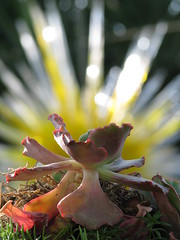
    sunburst
  • the Ascent
    Cucumber Falls
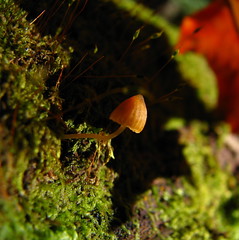
  • Entry into the Woods
    tiny mushroom
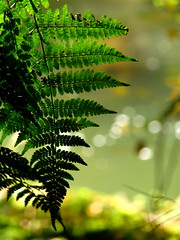
  • Walking along the Brook
    Fern over a lazy river
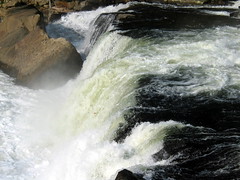
  • at the Waterfall
    Ohiopyle waterfall
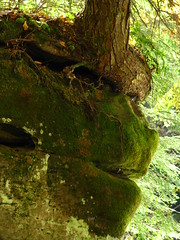
  • a Visual Feature / apparition
    grant me 3 wishes
  • on Flowery Meadows
    Bachblüten
  • on the Alp / Pasture
    I Can't stop loving you..
  • Wrong Path through the Thicket
    Don't leave now...
  • on the Glacier
    reflections of grass
  • Moments of Danger
    Hercules waiting for his replacement
  • at the Summit
    Austria / Österreich -- 1982
  • Vision
    alive and bright
  • the Fog Rises
    a grand day
  • the Sun is Gradually Obscured
    Something beautiful awaits!
  • Elegy
    beautiful day
  • Calm before the Storm
    Dusk
  • Thunder and storm, Descent
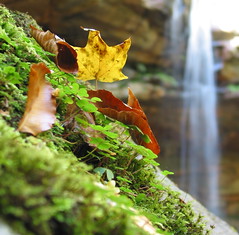
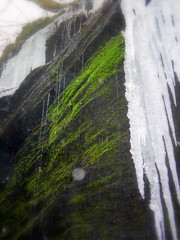
    Moss at Buttermilk Falls
  • Sunset
    Subtle shades enhanced
  • the Journey Ends
    sunset the other day
  • Night
    3 planets

Eine Alpensinfonie

Apparently Strauss viewed his work as more than descriptive, Austria / Österreich -- 1982but rather "philosophical" --
"in it there is: moral purification through one's own strength, liberation through work, and the worship of eternal, glorious nature."

I believe that through current financial and political strife, this symphony is a perfect way to cut through all the events of the world which may overwhelm. Today we can learn to abide or respect these words. What better way to deal with the overwhelming political conflicts than through 'moral purification through one's own strength,' for one's own truth and compass should not be deflected by everything around us. We should stand for ourselves and walk, as if we were on an alpine journey, through the strife with a smile on our face and our own strength to guide us and keep us moving with grace. Keep in mind this symphony was completed and performed in Berlin and Philadelphia during WWI. That fact seemed to escape the abridged historical guides I've read.

'Liberation through work' - this enduring ethic is timeless. Now we must imagine the work that Strauss put forth to complete this magnificent and grand symphonic poem, the height and breadth of a grand and majestic alpine mountain. His own liberation was through his work to complete this epoch in epoch times. We should emulate his resolve!

'The worship of eternal, glorious nature.' - In the final analysis, this is the one true saving grace for all of us. A common theme that none can deny, a simple base upon which we can all stand in agreement, that the beauty of nature is worthwhile. So to hear this beauty in such a grand and aural poem as the one fashioned by Strauss and played by our symphony is an experience I anxiously await. I hope the experience I can grasp and hold on to, to undergo a sort of transformation of spirit in our own uncertain times of turmoil. We don't need change, we need a beautiful expression to hold on to, a moral regeneration to our own deeply held beliefs, a work ethic to grasp and employ in times ahead. Our liberation will be one of truth and beauty through nature.

Saturday, October 18, 2008

Pittsburgh, Bohemia and the wild wild west


Three completely different pieces were presented at tonight's concert. Since two of them were presented in the first half, and I've never heard them before, it is difficult for me to remember all the aspects I know were floating through my mind at the time. "The Good Life" made its premiere. Well the good life started out cheerfully, full of smiles, and it ended up that way, and along the way there was strife. But what I remember was the quality of the music. The Mendelssohn Choir was fabulous, as were the soloists, and mixed with the symphonic music, the combination made a big impact on me. I wish I could hear it again for comparison and to reinforce my impressions. To me the music was fun, not in the same sense as the symphony to follow the intermission. It was purely a joy to listen and to watch this beautiful composition performed so beautifully. I was smiling the entire time.

The links, photo and post concert chat probably do a better job than do my words.

After the symphony I joined some friends at a restaurant across the street, including my friend who I've known since 1980, originally from Romania where he grew up. I wondered if Romania was part of the original Bohemia, the home of Dvorák. His reply was that from America, it might appear they were the same, but not so close from over there. However, they were neighbors in a sense. My analogy was to compare Dvorák with my friend. Now we know that Dvorák came to America and stayed a while. Here he wrote much of the symphony we heard tonight. My friend, from Romania, came to the USA by escaping the communist rule when he was still a youth. But my idea is that they both came here and were impressed by the vastness, perhaps by reputation of being 'big' or by actually experiencing our breadth. Perhaps this symphony represents the idea of America, our freedoms, our vastness, our individualism, and our wild wild west. My friend tells me of a story when he want on vacation out west and played the 4th movement of this symphony again and again. His description is that the force of this movement eloquently describes this land. I've had that same idea myself. Now the historians tell us differently, that Dvorák didn't experience that directly, but wrote much of this in New York. That his symphony was sort of an email message back home because he was homesick. That version isn't very romantic. I like my version better: What is to prevent us from believing that his imagination did not conceive of this vastness when composing? It is the idea I like to keep, to have and to hold in my particular imagination of this symphony, the beauty of the land, the country and the music seem to all go together, however it might have come about. It just is, and it is, beautiful!

Well we discussed this at the table, and another fellow who was born in the Czech Republic (Bohemia) agreed with my idea that we should best listen to music, especially new music, and interpret for ourselves what it means, without influences from the written words to tell us what the music is really supposed to mean. Art is abstract, and why force people into a mold of understanding. I listen first, form my own opinion, using my own creative mind to do the interpretations and colorations. Then I read the notes to see what it was 'supposed' to be, and I compare. Sometimes they are the same, but more often than not, they differ, and what's wrong with that. It's supposed to be fun and entertaining. I guess it's the individualist in me, the wild wild west rugged individualist, that likes to play it my way, without being told, that feels that way, but I found at least one other who agreed at the table.


Wednesday, October 15, 2008

This is a new country

reflections of grassDvorák New World Symphony.
This music invokes these words in my soul.
One must hear the music to understand the words, as I do. Written today, but heard in my mind many times before, while listening to this beautiful music.

1st movement
0:55

Come with me,
hear with me,
stand with me,
see with me,
a country..

2:00

yes, my country,
blend with me gently,
green and sultry,
roll with me bluntly

3:38

so heavenly blue,
as refreshingly new,
and everything grew,
oh forever renew

4:20

sweet, my country,
love the land nearby
flying as a buckeye
meandering into the sky
hovering over my eye

5:00

as my country,
living beneath a tree
as my country,
living as free as me

5:40

don't you see it
don't you hear it
don't you sense it
now in transit

5:50

as a country,
wide expansive country
live a country,
as a new world country

2nd movement
0:48

This is my country,
land that I do love,
growing free, part of me,
gather what I'm of.

1:16

Come with me
see with me
what we dearly love
gently
pastorally
slumbering above

1:28

This is my country,
revel in my land,
mountains high, rivers ply,
footsteps in the sand

3rd movement

consummate freedom
try my liberty,
passionate nectar
quaff me heartily,

crystalline humor
wit is levity - brevity - remedy

4th movement

This is a new country,
tranquil as a dove,
one new world discovery,
forever a land that I love

Welcome to my country,
seen high from above,
this land is an ecstasy,
said highly enough, I love

Wednesday, October 8, 2008

Revered again

As is my wont, I'm writing poetry to psych myself up for a Pittsburgh Symphony Orchestra concert this weekend. These are my words, just written to the music of Sergei Rachmaninoff : Symphony No. 2revered again

Revered again

Often when I'm up against a wall,
and the very simple words I scrawl,
easily reveal my thoughts to you,
as words I hope that do enthrall

Exposing whence my sleeping heart did fall,
back out onto center stage again,
and the wonder of our dream as when,
I could really have that kind of gall

Whosoever
dares to tell
that kind of truth
in this very soft and cloistered world,
can be cheered
but not revered
until they're mired
in dire understandings least unfurled

Abstract wisdom of the past is clear,
mixed with current subtle sounds I hear,
probing rhythm of my thoughts appear,
I'm trusting you my dear

Reveal our truth
together
inspire trust as freedom
unaffected nature as simplicity

www.youtube.com/watch?v=LrKdPDiBZTI

I believe Pittsburgh is projecting wall art on the buildings this weekend:

Sunday, September 28, 2008

Seeing is Hearing

Behold what wonders I observed last night. Seeing and hearing brought several new dimensions to this experience. Listening to a live performance gave a magnificent dynamic range to my ears. Not only is this range greater in frequency, but subtle changes in volume, attenuated on a recording, are often intensified at Heinz Hall. Sounds not heard on the radio the night before, were easily detected and enjoyed. For instance, the beginning of the Mahler Symphony was so slight, that I did not hear it at all on the radio until it was well underway. Then came the three trumpet calls from well off stage. That was barely audible on the radio, easily heard and enjoyed at the concert.

Try this: go to a symphony concert and watch an individual instrument throughout a performance, see the sounds. Somehow our minds are able to focus, and seeing becomes hearing, as astonishing as this may seem. For instance, in the Titan Symphony, I watched the harp from time to time. The beautiful plucking was easy to perceive once my attention was so directed. Later, I would automatically know that sound, and know it was the harp, even without seeing anymore. This became a memory of the sounds and an association, perhaps a visual association, which stuck around and built upon my knowledge of the orchestra and individual instrumentation. Watch the string section. Their fluid rhythmic motions bring sweet harmony and melody alive. I'll hear their phrasings on one side, and pizzicato on the other, then sometimes reversed. Occasionally the principals will play a section of the score, their motions pronounced along with the music, accenting and drawing my attention. Seeing is hearing.

So many different instruments were used with the Adams composition and the Symphony. This amazing array and assortment is fascinating to peruse. If seeing is hearing, then it is also true that hearing is seeing. In the Adams: 'Short Ride in a Fast Machine' I am instantly hearing, then seeing the amazing score driven initially by a wood block making time. There were 2 flutes and piccolos, 2 oboes and English horns, 4 clarinets, 3 bassoons and contrabassoons, 4 horns, 4 trumpets, 3 trombones, tuba, timpani, woodblock, triangle, xylophone, crotales, glockenspiel, suspended cymbal, sizzle cymbal, snare drum, pedal bass drum, large bass drum, large tam-tam, tambourine, 2 synthesizers, and strings. What fun it was to see and hear each of these being played in such a synchronized form, making the difficult seem like a breeze.

Again, in Tchaikovsky’s Violin Concerto, I was able to see the music, only this time it was the soloist Joshua Bell that drove this point home. He made his red violin sing for joy, bringing it figuratively alive. The notes stored in his mind have become more than a simple sequence, but a fluid continuity of form brought out.

And finally, it was Maestro Honeck who epitomized the ultimate universal language of motion and form, conducting the entire whole of the symphony as if the sounds were emanating from the very tip of his baton, and merely reflecting through the musicians and amplified back to the audience, in a sublime metamorphosis which transcends temporal reality and enters the realm of the interminable.

Come to the symphony, and see and hear for yourself!

Friday, September 26, 2008

resoundingly beautiful

resoundingly beautifulLet's place the Tchaikovsky Violin Concerto next to the Mahler Titan Symphony, and see what we might find.. A penultimate comparison of Russian and German style. These thoughts are mine, with little influence from the published descriptions; I like to add my own thoughts and impressions of the music with undue external prejudices. These impressions heard tonight on the radio broadcast of the PSO at Heinz Hall.

Is the Tchaikovsky Violin Concerto monumental? They say that Beethoven and Brahms' concertos are monumental, but I'm here to interpret my own impressions. I care less if it is monumental, because I know it is beautiful, as a flower is pretty and aromatic. I leave the logic, issues and reason at work. It is night now, I'm trying to escape from the doldrums of the mundane and into the magical mystical world of classical music.

I'm finding such wonderful emotion and feelings in the music that make my heart and fingers race. The music is like a cacophony of insects buzzing all around the assortment of blossoms in my garden. Often so abundant, quick and racing, then occasionally only a single voice is heard, like a butterfly darting and bounding up, down and around in impossible patterns and eloquence, defying gravity, inertia and logic. But the harmony is there, and the relationship to the rest of the nature is abundant and smoothly combined with divine melody and dramatic flair. The culmination of this amalgamation is joy.

Mahler's Titan Symphony no. 1. überwältigend. Es hallt wider. It reverberates with natural splendor. A compelling, sweeping robust composition. The beginning, a fresh morning dew filled experience with nature's sounds awakening. The second movement, my mind envisions a resounding scherzo full of melodic character. The third movement, a stunningly subtle cross over, Bruder Martin - Frère Jacques - ding dong ding. The fourth movement, complex, seemingly overwhelming. Overall, a vast, mind-blowing experience, yet never overly vexing nor audibly saturated. Altogether a truly a titanic composition, in range, breadth, depth and pastoral style.

Nebeneinanderstellung

FairiesThere are several reasons why I began to learn German 15+ years ago. I have a German sir name, 1/4 of my ancestry stems from Germany. I visited Europe many years prior, and intend to return; I wish to converse with the people / Leute. But the biggest reason was this: to understand the language that is behind much of the classical music I love. Other than the great masters from Italy, I am most fond of the classical music written by Austrian and German composers. Some of that music has inspired me so much, that I have a desire to understand the words behind this music. One such composition is Beethoven's 9th symphony.

Lest you think I'm off topic for this weekend's concert, I will show a few links: Mahler and Honeck, both from Austria, both with the native German language. So that is my tie-in, my juxtaposition, my reason for listening, learning and writing. The German for juxtaposition is Nebeneinanderstellung. One really cool thing about the language are these really long words, it can be broken down thus:

Neben - next to
einander - an other
stellung - position

Nebeneinanderstellung - next to another position - juxtaposition

So here I am standing next to myself, writing in two languages, listening to several compositions on the radio, and marveling at the beauty.

Let's place the Tchaichovsky Violin Concerto next to the Mahler Titan Symphony, and see what we might find. Let's place Friday night's performance (which I will hear on the radio) next to Saturday night's performance which I will hear in person at Heinz Hall... to be continued...

Incidentally, Einstellung can mean employment, amongst other translations. Let's hope Manfred Honeck's employment and tenure with the PSO is a resounding success!

Wednesday, September 24, 2008

Titan

I'm looking forward to the auspicious beginning of Maestro Honick's career with the Pittsburgh Symphony Orchestra this Friday and Saturday. Friday's concert will be simulcast on WQED FM 89.3

Indeed it is beneficial for Pittsburgh and fortunate for me to hear some of the music from many composers from his home town of Vienna, Austria, including Beethoven, Strauss and Mahler. Although I am quite familiar with most composers of classical music, somehow Mahler has escaped my hearing almost completely. I can't quite say why that is, but this weekend's propitious opening of the Mellon Grand Classic series offers for me a unique opportunity to kindly right my unfortunate oversight, with Mahler's first symphony: "Titan."

It is advantageous to listen to Mahler's music at Heinz Hall where the acoustics bring the sounds alive. His music overlaps the Romantic (1815 - 1910) and the Modern (1900 - 2000) periods of classical music, which might be part of the explanation as to why I've not heard Mahler's works, my preference previously tending to preceding eras (Baroque, Classical and Romantic). I find that when being introduced to music previously unheard, the best way to persuade my ears as to the profundity of the experience is with live music. That's why I urge everyone to attend for themselves, find out what I'm referring to by listening at the concert. The radio is nice, but it's not the same thing as being there.

Of course if this is not reason enough for you, then consider that Joshua Bell will be performing the solo with the PSO in Tchaikovsky's Violin Concerto. Additionally we will hear Short Ride in a Fast Machine, a pounding thriller sure to thrill, composed by John Adams, one of the most influential composers of our time.

Honeck on TV

Tonight the moon shone bright while thrushes migrate in the nighttime sky. I peaked out to see the beauty, but only for a minute, because I didn't want to miss a special television program on WQED on incoming conductor and Music Director Manfred Honeck, of the Pittsburgh Symphony Orchestra.

I was impressed by the goals of our new maestro. I'm paraphrasing, but essentially it was often stated in the program that his goal was to convey great music. He would not be satisfied unless the audience left the concert hall remembering the music. To him, it seemed, that the music always came first.

This show was well produced, and the first half filmed in the city of Vienna, Austria, Maestro Honeck's home. He originally grew up in the country, a man of my own heart. I visited Austria in 1982, and was well impressed with the beauty of the the countryside as well with Vienna the city (Wien in German language).

I'm also impressed by his mastery of the English language. I myself have been learning German for quite some time, but I profess that my skills are no equal to his English ability. His speaking style, a slower and more deliberate method more like those of Austria than Germany, and the timbre of his voice, show the warmth of his personality. They claimed he is a musician's conductor, being concerned with the needs of the musicians, apparently he is very popular with the musicians of the Pittsburgh Symphony Orchestra. Having seen Maestro Honeck conduct last season, and watching the program this evening, I find his goals, temperament, style and abilities quite the perfect match for a conductor that I can welcome with open arms to Pittsburgh.

Tuesday, September 23, 2008

brevity is the soul of wit

Yesterday while driving home from playing Ultimate Frisbee, I listened to a beautiful violin concerto, described by Ted Sohier of WQED 89.3 as being the world premiere recording, perhaps not heard in over 200 years. "Therefore, since brevity is the soul of wit, and tediousness the limbs and outward flourishes, I will be brief:" Why not bring this beautiful concerto to our ears, live, next season at the PSO? And perhaps the solo performer of this CD would be interested:

Franz Clement: Violin Concerto in D Royal Philharmonic / José Serebrier
Rachel Barton Pine, baroque violin

Franz Clement's name has come down to us as the dedicatee of Beethoven's Violin Concerto, but a year previously, in 1805, he wrote his own Concerto in D, and it's a major find. This is no orchestrally challenged, formally dysfunctional, tasteless virtuoso vehicle, but rather is a full-blown classical concerto nearly as long (40-plus minutes) as the Beethoven. The melodic material is consistently attractive--and just as importantly, equally interesting harmonically. Deftly scored, and of course wonderfully written for the violin, its lyricism clearly anticipates Beethoven's own work of 1806. It goes without saying that Rachel Barton Pine plays the work with the style and elegance that it deserves.

Thursday, September 18, 2008

Beauty divine

watching and waiting

This morning while driving to work I was listening to Rachmaninoff Concerto N. 2 - II. Adagio sostenuto on WQED FM 89.3. (here are a few links to other performances)
youtube.com/watch?v=llveGVApdz4
youtube.com/watch?v=aseYsowHj4E

It is beauty divine! I urge everyone to listen to this romantic concerto, especially the second movement in particular. I always experience goosebumps with this fantastic music, and this morning was no exception!

My last post on this music inspired poetry

Monday, September 15, 2008

Musical Chairs

Pittsburgh Symphony/Heinz Hall as viewed from outside the grand tier seating area and down to the stage where bokeh shows a harp and more:
grand tier and bokeh harp

Alliteration

In symphony season soon to start
I snapped a shot from stage to sight
bokeh harp bore better gold
than token thus with grand tier right

You see this season begins with a preview concert, and and what better way to begin the season, but with a 'best of the season,' complete with general seating where we all pick our own seats, first come first serve. It was sort of a game of musical chairs this evening, both literally and figuratively, in more ways than one. We would hear Mahler: Symphony No. 1 in D Major, 2nd movement, but then the music would stop, and one fewer chair would remain (figuratively). With this movement I discovered that the Grand Tier seating area of Heinz Hall really does have better acoustics for the horns and woodwinds, which always seemed to be over-damped a bit when I sat on the main floor last year. To continue with my metaphor, we would later hear Dvorak: Symphony No. 9 in E minor, "From the New World", 1st movement, and again the music stopped, another chair was removed, and the audience clapped. During a regular concert, if the audience claps after the 1st movement or anything but the last movement, it becomes a point of etiquette, not knowing the right time to applaud. And next, and most deliciously, we had the Mozart: Symphony No. 38 in D Major, "Prague", 3rd movement, (here we see Manfred Honeck with the same movement, one that I like to think of as a musical joke). Perhaps Mozart was playing musical chairs with this symphony as it only has 3 instead of the typical 4 movements.

Now of course every time the orchestra paused, Jim Cunningham of WQED 89.3, our host for the evening, would eloquently introduce the next piece, and behind him they would be literally rearranging the chairs, as in the allegory of musical chairs. His purpose and their goal was to try to sell season subscriptions to many of the attendees who were not current subscribers. Along the way he told a few good jokes and somehow we all became familiar with German Jelly Donuts and the wonderful waltz by Strauss: "Im Krapfenwaldl," complete with coo-coo and bird sound effects! The final piece of the evening was Beethoven: Symphony No. 7 in A Major. 4th movement, one of my favorite pieces of all time. I envisioned I was a bird soaring high above the land, in tune to the music, up, over a rainbow, where skies are blue.

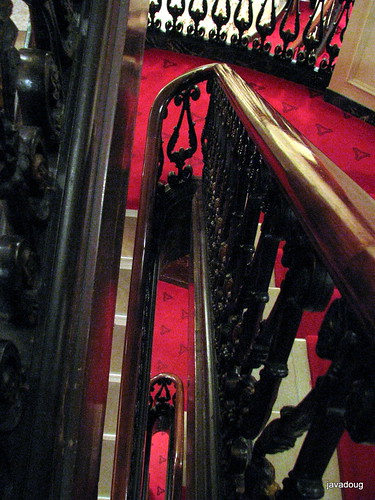
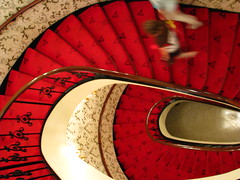
Several other single movement spiral staircasecompositions were played this evening, but I don't want to forget to mention one I really liked, because the soloist poured her heart and soul into the violin: Bruch: Scottish Fantasy for Violin and Orchestra, 4th movement, Laura Motchalov, violin; it was simply beautiful.

One more interesting note, on my way home, with my daughter and her friend, they with their ipods, and myself with WQED on the radio, I was listening to a wonderful piece I've never heard before by Gottschalk: Symphony No. 1, A Night in the Tropics, I & II Utah Symphony Orchestra/Abravanel. And the girls were listening each to their own separate music, and singing out loud, Eat It by "Weird Al" Yankovic and Aly & AJ - Potential Breakup Song. What a symphony of sound!