Sunday, September 11, 2011

PSO 2011 Euro Tour - Mahler Sym 5 in Berlin

Symphonie Nr. 5 von Gustav Mahler - Live aus der Berliner Philharmonie

Under the leadership of music director Manfred Honeck, the Pittsburgh Symphony Orchestra performs on 11 September 2011 at Musikfest Berlin. Live stream of Mahler's Symphony No. 5 by the orchestra is dedicated to the victims of the terrorist attacks of 11 September 2001.

Manfred Honeck says in a statement:
"The 10th Anniversary of the terrorist attacks of 11 September 2001 is of great global importance. For the people of Pittsburgh and Western Pennsylvania, they have a very special place: one of the four planes crashed in a field near Pittsburgh after passengers on board intervened. These brave men gave their lives for the lives of others. To you and all the victims of September 11, the Pittsburgh Symphony Orchestra dedicates this global stream of Mahler's Symphony No. 5 from the Berlin Philharmonic. "
--link--


Saturday, June 11, 2011

A Day - a sequence of events - Rapture


She was there, at Heinz Hall, and I shook her hand. But I'm getting ahead of myself...

Writing is hard. Writing is difficult. Difficult is writing. I never once had one lesson. Just a few random thoughts as I prepare to describe tonight's concert. And of course I'm sitting here in front of the computer thinking of what to write, yet the concert was several hours ago, and I've already forgotten umpteen fabulous thoughts I wanted to say.

Manfred Honeck spoke at the WQED reception following the concert this evening. He is very soft spoken - his tone of voice is almost hypnotic - one can't help but like him for this intonation and of course for his marvelous smile which we see after the conclusion of every piece he conducts, during the applause, when he appears at the beginning of a composition, and of course tonight at Heinz Hall.

This day has been a long and deliciously full one. I took off work to take my daughter and her friend to the 3 Rivers Art Festival. The weather was perfect and the art was just amazing, yet that was just they day. Now it is night and I'm looking out the window - I see darkness. What many fail to realize is, is that a writer is working even when looking out the window, night or day. But I digress.

Whence the transition from day to night first began to happen, I cannot pinpoint precisely. Between the last shadows of sunset, and the beginning of the first selection came a horde of concert goers into Heinz Hall, a time of waiting as I watched the PSO musicians joyfully practice, and Manfred Honeck enter the stage with his usual grinning flair, where he would quickly commence Walter Braunfels' Fantastic Appearances of a Theme by Hector Berlioz. I took notes during the Fantastic Appearances, and of course I can barely read the now. I see the word 'chase' - oh yes, one of the movements certainly seemed like a chase, a marvelous fancy of flight, with the various sections of the orchestra each dancing their way in and out of the movement. Then came a slower more romantic movement which showed off the beauty and power of the string section, followed by a scherzo with a sort of question, brewing, building, with a hypothesis of thought - a conjecture which was only to be answered by 'Mit Breite, doch nicht zu langsam und etwas frei' which, translating myself means: 'with breadth, just not too slow and somewhat free'. I really enjoyed this piece (even thought it wasn't the whole composition) and am glad Manfred Honeck brought it to us this evening.

Beethoven's Piano Concerto No. 4 with Emanuel Ax, piano. Now that's enough to draw me to the concert this evening. Ax's performance was simply magnificent. I also enjoy watching him play. I spoke to a few friends at intermission. One indicated that Ax's hands remind him of Beethoven himself. Another sat close enough to observe that as Ax would strike the keys, occasionally it seemed as though he was moving his hands in a sort of vibrato, normally associated with a stringed instrument. [Vibrato is a musical effect consisting of a regular pulsating change of pitch. It is used to add expression to vocal and instrumental music. Vibrato is typically characterised in terms of two factors: the amount of pitch variation ("extent of vibrato") and speed with which the pitch is varied ("rate of vibrato").[1]]

As I listened to Mr. Ax play the piano, I was struck by the sheer number of notes being played. They say that Mozart wrote a lot of notes, but I'd say that Beethoven has him beat. This particular concerto is so full of notes for the piano, it prompted me to try to estimate the number. Let's say he played for 20 minutes, at 6 notes per second per hand. That comes out to about 14400 notes. Anyone know if I'm close?

I also noticed how peppy Mr Ax is when he plays and when he enters the stage. He seems to be truly enjoying himself in his performance. Between phrases of the music, I often see him looking up at conductor Honeck, and of course that's all part of the timing, but when he looks he's smiling.

Ok, so when I write I sometimes procrastinate. Even this late at night. Yes, I put on the TV. And I see there's a show called 'What makes Pittsburgh Pittsburgh' Which reminds me, after the concert Jim Cunningham gave Manfred Honeck several presents. One was a case of Austrian Beer: Another present was some polish beer. Okay, I think I'll try either kind, but my preference might be for the Gösser Bier. Sind Sie über 18 Jahre?

Brahms' Symphony No. 4. Now that's rapture. What else can I say? The first movement seemed to be the same kind of development that was made famous by Beethoven. Somehow Brahms took 2 notes, and developed them. At least to my ears that's what I heard. Sure, there were many complex dynamics built into the movement, yet you can't mistake the various places where those same two notes (not the same pitch every time) are repeated again and again, sometime going up, sometimes going down. And then there are 3 then 4 notes.

The PSO seemed very well balanced with this Brahms symphony. Ever part of the orchestra was easily heard. The 2nd and 3rd movements are very familiar selections to anyone who's familiar with classical music. Yet when they got to the 4th and final movement I couldn't recognize it - I'm not sure why.

I met a fellow blogger again tonight - Jennifer. And that opening line was just the hook, and now you have the resolution. Jen and I were both at the reception following the concert. I didn't see any of the other bloggers, even though I thought there might be a few. It was a nice event, hosted by WQED, and of course coordinated by the staff and employees of the Pittsburgh Symphony Orchestra, who did a great job of making it so much fun.

Friday, June 3, 2011

A Conspicuously Sensual Symphonic Theme

There was no overt attempt to mask the conspicuously sensual symphonic theme this evening that Manfred Honeck and the Pittsburgh Symphony Orchestra delivered before our hungry ears. The beautiful music was placed right out there before us, the listeners, to hear and to enjoy. The four selections all shared a somewhat romantic, sometimes modern, yet indelibly satisfying music that quelled an insatiable appetite for sound, simply for the sake of the aesthetic pleasure in relishing the resonance, vibration and intonation of each accented note, each symphonic chord that strikes deep within the soul, and scores with musical tones; no words, just glorious notes.

Richard Wagner's Lohengrin prelude to act 1 is a favorite of mine. I know, I've indicated that so many selections are a favorite, but this one really does stand out near the top of the list. A fan of Wagner, yes, and yet this is the first time I've heard Wagner live in concert. And wow is all I can think. I'll listen to this music over and over and yet never grow tired. It's motivational, as if to make one's mind soar beyond the bounds of our physical, to contemplate what's beyond the possible, to grasp a higher plane, mere words cannot say, the present is a realm which now approaches the infinite. And then it gets better, louder, more meaningful as the percussion and horns brazen a flourish, then strings bring the subtle meanderings around to gentle resolution - and it is profound, found again and again with an ending reprise. And I'm wanting - to hear it again.

This is immediately followed by the premiere performance of Alan Fletcher's Concerto for Bassoon and the Pittsburgh Symphony Orchestra, commissioned by and for the PSO with Nance E. Goeres. I always enjoy listening to new selections, it's a chance to experience something for the first time, and to concentrate on the music to try to understand it's meaning, its aesthetics and its impressions. I liked this concerto from the outset. Nancy Goeres did such a great job at introducing the concerto beforehand, and with the solo selections, it seemed amazing - some long and drawn out, and others quick and technically challenging - with a dynamic range on the instrument that seemed quite wide and ranging. Alan Fletcher did a great job of blending the Bassoon with other instruments, and the PSO, led by Honeck, blended the parts quite well. With the harp, it sounded like a perfect amalgamation, with the drums a clever counterpoint and often a sonorous march, with the large cylindrical bells (what are they called) it was a metronomic duo, and with the strings the Bassoon would soar. This concerto has something for everyone, starting off like a Shostakovitch modern sound, then moving to the second movement with a slower more romantic andante, then ending with building march-like rendition more classically structured, where entropy equalizes counterparts, and at the end, it was a sudden conclusion, not typical, and surprising, perhaps the bet way to conclude this addition to the concerto repertoire. All three movements received well deserved applause.


Monday, May 16, 2011

Honeck, Grimaud & Tower

I'm going to miss Joan Tower's appearances at Heinz Hall to introduce her music. I've hear 4 or 5 of her compositions this season, and each one is fascinating in its own way.

As I mentioned in another blog post, the composition I liked most was 'Sequoia', which she wrote 30 years ago, and is by far the longer, but not necessarily more dynamic. All of her pieces are interesting, and after hearing 'Stroke' I find it to be the most dramatic, probably because of the way it fits so well to the subject matter.

This weekend last she introduced 'Stroke' which she dedicated to her brother who had a stroke. Apparently he was able to virtually attend this concert, because she indicated that the PSO arranged for it to be 'Skyped' to him. Technology can be an amazing and wonderful thing.

This composition, as well as the 'Sequoia', was able to capture the metaphorical musical representation of the phenomena she was attempting to portray. It was a bit of a scary journey, and the PSO handled the composition well. Just as Sequoia made be feel the vertical height and breadth of the massive tree, Stroke gave me a sense of the terrible debilitating effect.

Of all her compositions, Joan Tower indicated that Sequoia was the most difficult, and almost apologized for it to the orchestra members, way during the introduction. This was her last appearance this season with the orchestra.

As I said, I liked Joan Tower, and will miss her. She seems to be a down to Earth person, and at the same time we've seen the genius in her compositions. What a great combination.


Hélène Grimaud, piano
Manfred Honeck, conductor
Wolfgang Amadeus Mozart: Piano Concerto No. 23, K. 488

Hélène Grimaud has a great smile, and great hands. Really, to see her hands range up and down the piano, and to hear that beautiful music with the fabulous Mozart concerto no. 23, was a real treat. I took photos of her at intermission, and with every person she beamed a beautiful smile, it was infectious. My only regret was that I didn't get in line to get an autograph myself, because the line was too long and I'd miss the second half of the program. I hope the PSO has her back again.

One more reason I like Hélène Grimaud -- her fascination with nature and wolves: "Wolves are like most wild creatures," Grimaud says. "They want to be left alone." I can relate to that myself with my frequent trips to nature, with only my camera in tow. At the Westmoreland Conservancy in Murrysville, the signs sometimes say: 'Leave only footprints, take only pictures'...
Yawn

Saturday, May 14, 2011

Hélène Grimaud, Mozart: Piano Concerto No. 23


Hélène Grimaud, piano
Manfred Honeck, conductor
Wolfgang Amadeus Mozart: Piano Concerto No. 23, K. 488

Sunday, May 8, 2011

Final Alice with Hila Plitmann and the PSO


Final Alice is based on the last two chapters of Lewis Carroll's Alice's Adventures in Wonderland and is sung by soprano talent Hila Plitmann. This performance was completely amazing. I was was nothing less than 'awe-struck,' that's the best way to describe it. I didn't really take notes during the performance because I wanted to really just sit there and observe.

Hila Plitmann basically stole the show, and well she should because it centered around her performance as Alice and all the rest of the characters in the story. The symphony at times would play loudly, and occasionally drown out her voice, yet I was still mesmerized. Some of the scenes were way out there, like nothing experienced before. Others were softer and very tonal, with memorable melodies and music.

During the post concert chat with Leonard Slatkin, Hila Plitmann and composer David del Tredici, conductor Slatkin asked Ms Plitmann "How do you prepare for this?"

Ms. Plitmann: "It's the best challenge out there. I had an interview the other day, and I was told about something you had said about what it takes to prepare for something like this as a singer and I feel that the wonderful think for me, I don't know how it happened in my life, but somehow the set of skills that I have seem to fit with this. There's a lot of things I can' do but this I seem to be able to do."

Mr. Slatkin: "The range, low-A to high-D, so we're talking two and a half octaves"

Mr. Tredici: "But I think the terrible thing is how it sits high for so long. The occasional high note is not so hard but a low note is high-A, I mean the way it stays there, in that first aria. Then you have to talk - I was wondering, is that a problem to talk and sing, alternating it?"

Ms. Plitmann: "It's not so much while it's happening, right now you can hear my voice is a little, sounds like a chipmunk, and that's part of the process of having to do something like this"

Audience question: "I have to commend you on that tremendous performance. It's incredible to even memorize that sort of body of work, and to work in not only the opera, but the speaking parts and know the story line and the timing -- that's just an incredible thing. While that popping was going on (problem with the microphone) to keep your train of thought, that was amazing" [My friend Miklos Sarkozi]

Ms. Plitmann: "Thank you so much."

Mr. Tredici: "And let me say, the way that Maestro Slatkin shaped one hour - the way it was shaped makes an enormous difference - it was just masterfully done."

Mr. Slatkin: "It's a journey, the fact that the piece begins and ends the same way, with that one note in the oboe, it sets off the journey, and I've done this piece 5 or 6 times over the course of 5 years."


I anxiously await the next time Hila Plitmann appears with the PSO!


Post-Concert Artist Chat, discussion of Final Alice, with conductor Leonard Slatkin, Hila Plitmann and composer David del Tredici.


ps: sorry this post is late, I've been busy all week taking photos of immature Great-horned Owl chicks...
instant dilation!

Variations on a theme by Prokofiev

Peter and the Wolf had a distinctly Pittsburgh theme this weekend past, performed by the Pittsburgh Symphony Orchestra, conducted by Leonard Slatkin and narrated wonderfully by David Conrad. I've never seen Mr Conrad on TV, but in person, he did a great job narrating the Peter and the Wolf, especially with the variations which included some of the following:
  • Penndot
  • Doppler Radar
  • Traffic on Greentree Hill
  • Most livable pond (for the duck)
  • 'Yins can't flap
  • Leaving Lawn Chairs to reserve parking space
  • Cat named U.P.M.C
  • Meadow - near Cleavland
  • Orange traffic cones
  • Steeler Man
  • Scratch my back with a hacksaw
  • Double Yoy
  • Blond woman reporter on the scene
  • 15 yard penalty
  • Empty bankrupt IC beer cans
  • Still haven't gotten over the Superbowl
  • Tail-gating parties
  • Father was Charlie Sheen
  • Sitting on a natural gas bonanza
  • Sick and tired of the whole Frackin' mess
It was very humorous, and the music by the symphony was delightful.

Saturday, May 7, 2011

Twisted Storybook Favorites with the PSO


Stage at Heinz Hall, Twisted Storybook Favorites with the PSO


Concert Prelude, discussion of Final Alice, with composer David del Tredici and Marah Gubar, Director of Children's Literature program and faculty at the University of Pittsburgh; moderated by WQED-FM's Jim Cunningham


Mad Hatter at Heinz Hall lobby, Twisted Storybook Favorites with the PSO


Artist at Heinz Hall lobby, Twisted Storybook Favorites with the PSO


Artist at Heinz Hall lobby, Twisted Storybook Favorites with the PSO


Twisted Storybook Favorites with the PSO


Post-Concert Artist Chat, discussion of Final Alice, with conductor Leonard Slatkin, Hila Plitmann and composer David del Tredici


Post-Concert Artist Chat, discussion of Final Alice, with conductor Leonard Slatkin, Hila Plitmann and composer David del Tredici


Items on Display at Heinz Hall lobby


Alice's Adventures in Wonderland illustration by Salvador Dali


Alice Liddell photo by Lewis Carroll, Heinz Hall lobby


new sculpture at Heinz Hall

Saturday, April 9, 2011

Ohlsson and Blomstedt with the PSO

This evening was a rare treat - Herbert Blomstedt conducting the PSO, and Garrick Ohlsson playing the Brahms Piano Concerto No. 1 - also the Brahms 1st Symphony - what could be better?

Before the concert began, I spoke to an acquaintance I see often at Heinz Hall; he wanted to tell me that he read my blog post from a few weeks ago discussing Nicola Benedetti's appearance playing the violin with the PSO. He thought she was charming and beautiful, and his general impression was very enthusiastic. I was certainly pleased that he read and liked the blog :)

A musician of the PSO, English Horn in hand, introduced the concert as a very special evening, "The fireworks you hear tonight will come from us first, then across the river later" [after the Pittsburgh Pirates baseball game].

Guest conductor Blomstedt began the concert quickly and succinctly, with baton darting as if 2/2 time, smiling, and with his left hand he often seemed to be imploring the orchestra to bring forth the music.

The concerto led off with strikingly dramatic drums and strings, and soon Garrick Ohlsson joined on the piano. This Brahms concerto, at least the first two movements, were not familiarto me, thus my first real experience is yet again the beautiful live music from a fantastic soloist along with the PSO -- a great way to instantly draw a liking.

The woodwinds played like beckoning calls, and Mr. Ohlsson played 4 steps up and 2 steps down followed by English horn calls and the two main violins playing solo together. The sequence was interesting, but the part I liked best with this movement came next: ding-Ding on the keyboard in dramatic harmony with the orchestra in a somewhat faster pace and louder volume. Then a sort of love theme is played alone by the orchestra and the keyboard joins in. Here I find the effect somewhat discordant. Next the orchestra and the piano form a sort of alternating dance swaying back and forth, a thrilling bit of drama followed again by the horns and drum making harmony once again. The audience can't help but applaud after the end of the first movement.

The slow movement shows some of the beautiful technical and interpretive skills of Mr. Ohlsson. And it is the third movement that I finally recognize: and it was played to perfection.


After intermission I'm again struck by the constant pleasant smile from guest conductor Herbert Blomstedt. He begins the Brahms Symphony No. 1 with drums driving the tension and increasing the energy. He seems to have a wonderful rapport with the symphony. To me, the Brahms symphony seems to have all the right notes, there never seems to be anything awkward, each phrase is interesting and inevitable.

I sense a perfect synergy of synchronous syncopation,
saturating my senses with sublime syllables of succulent spectacle.
Sometimes subtle, sometimes sumptuous, smooth and silky,
scintillatingly sheer, soaring successive slippery slopes,
succeeding with superb sequences of symphonic splendors serenading my soul
- and that was just the first part of the first movement.

A powerful force came forth from the very domain,
encompassed my ears with sounds that aptly sustain,
with a subtle embrace,
filled with power and grace,
compelling a cadence of chords to the final refrain.

The symphony ended, and a standing audience applauded - and I smiled. Herbert Blomstedt aptly shook hands with the principle musicians; he then waved his hands in a low motion to the musicians of the Pittsburgh Symphony, as if to say: wow, this performance was great. When he reappeared the musicians stomped and rocked their feet on the stage and vigorously waved their bows as if to say thank you to the conductor. As a reward he initiated an encore of a part of the third movement by holding up three fingers. This was quite a treat, to hear it again, it was beautiful. Indeed we were treated to fireworks tonight!


Wednesday, April 6, 2011

Liszt's Thematic Transformation

I was unable to attend last weekend's performance, but was glad I could tune in to WQED-FM which broadcast the concert live. I managed to catch the second half including Liszt's Piano Concerto Number 2.

Out of interest I read Matt Campbell's post and how this was to be a new experience for him. I, on the other hand, have heard this concerto many times -- I purchased a CD years ago because I love Liszt, and I've literally heard it perhaps a hundred times in my car. So with that in mind I listened intently on Friday night. The tempo used by conductor Rafael Frühbeck de Burgos was somewhat slower than I was accustomed to, but it seemed to fit well. Pianist Jorge Federico Osorio played very well, and the audio quality of the broadcast came through very clearly. However I wished I was at Heinz Hall, where I could listen to the subtleties of the orchestra. Nevertheless, I was pleased to be able to listen to this stimulating composition by Liszt performed by the Pittsburgh Symphony Orchestra.

What I didn't know was that this was a concerto in one long part, instead of three movements. Even though I had the CD, it never occurred to me that this music was always moving forward, ever changing, without interruptions. Indeed, my new discovery of the idea behind this “thematic transformation", was a thrilling addition to the obvious adoration I have always had for this piece. And even on Friday night when I was listening, I was only mesmerized by the emotion and thrilling aspects of the music, and not concentrating on the details of movements.

The following paragraph is a concise description of Liszt the composer :

Liszt is music's misunderstood genius. When Robert Schumann heard Liszt play, he was struck most of all by the young musician's "tenderness and boldness of emotion." Clara Schumann, an important pianist herself, told her husband, "When I heard Liszt for the first time in Vienna, I just couldn't control myself, I sobbed freely with emotion." Although his popularity as a pianist was nearly unrivaled in the nineteenth century, his ultimate importance to music history is as a serious, boldly original, and even revolutionary composer.

Saturday, March 26, 2011

Scheherazade with the PSO

In a last minute change, the Pittsburgh Symphony Orchestra added a piece to the program Friday evening. It was the Requiem for Strings by the Japanese composer Toru Takemitsu, and it was added to pay tribute to those who have lost their lives in the disaster in Japan. It was quite a moving piece, obviously written before the disaster, yet a fitting tribute.

Paul Silver of the PSO viola section introduced the piece -- "with the understanding that emotional and spiritual healing must also occur -- we hope a spirit evocative of music, born upon gentle waves can make their way back to Japan, as they rebuild their lives."

Slowly, softly, the music began. It seemed to move forward, as if with steps, and often asking a question. The effect and use of dissonance seemed to tug at my heart, elucidating a a sense of sorrow. Yet musically very pleasant. Often different sections of the orchestra would start off at a different pace, and then end a phrase together again. I imagined it would be a difficult piece to play. At the end there was no applause, as requested by the introduction - just silence.

Next they PSO staff brought in the piano and the violin players returned. With that I imagined it would be hard for both the orchestra and audience to quickly switch emotional context. Indeed, the human spirit needs time to rebuild, but that's always what we do, we tend to rebuild.

With the Beethoven Co. No. 2, Johnathan Biss had no trouble taking up the melodic passages, blending elegantly with the Pittsburgh Symphony Orchestra. The synchronization with the orchestra was indeed exquisite - Andris Nelsons gets much of the credit for this - he was able to pull the orchestra in at just the right moment, keeping time with his baton like a metronome. Beethoven, being my all time favorite composer, can't miss with any of his music. And to hear it live with the PSO was a great treat. The last movement is the most famous, and was performed with plenty of alacrity by the soloist and the orchestra.

The last time I heard Scheherazade was on the boardwalk in Ocean City last summer.Scheherazade She played for donations, and really was quite good. She was an immigrant, from eastern Europe, Romania if I remember (I asked), and she indicated she was working her way through school. Now that's the spirit of hard work and doing what you love, even if it is as a way to help make extra money to try to accomplish your goals.

Indeed it reminded me of the story of: 'Scheherazade, the fictional teller of the stories known collectively as "One Thousand and One Nights" or sometimes "Arabian Nights". Doomed to death by a vengeful sultan, Scheherazade prolongs her life by telling the king a new story for a thousand nights. When she finally runs out of stories, the sultan has fallen in love with her and makes her his queen. Rimsky-Korsakov used the story of Scheherazade as the inspiration for his popular programmatic work, with its familiar musical (and literary) themes.'

This story came to me as an introduction to the performance, and I placed it here because it seems the perfect place to reflect on the human spirit. It keeps on working, striving to recover from setbacks, or to avoid pitfalls. This evenings performance was indeed an inspiration. And to say the least, one fantastic performance by the PSO, famously led by the guest conductor Andris Nelsons, who seemed to soar off the stage as he leaped in the air - I'd even see the reflection of the felt red of the podium on the souls of his shoes.

Saturday, March 5, 2011

Nicola Benedetti with the PSO

I was really excited to be attending the concert this evening with Yan Pascal Tortelier, conducting the Pittsburgh Symphony Orchestra, and to be a part of the premier of Nicola Benedetti here in Pittsburgh -- it's always a treat to experience new talent, and especially a young musician with the ability and temperament to perform the less-often performed repertoire as was the case tonight -- it was thrilling!

Before that, however, the PSO again performed 'Tambor' (drum) composed and introduced this evening by Joan Tower. The subject of the piece centered around percussion and rhythm. As she described, there were 3 aspects:
1) percussion as a backdrop, the drums as an eyeline to the orchestra with short repetitions coming behind, sort of an edge, then with the solo violin (performed by Andrés Cárdenes), 3 triangles acted as an icy backdrop.
2) a counterpoint and
3) percussion solos
It was all wrapped up into a sort of flowing music that I like to compare to the analogy given by Leonard Berstein as the kind of music which is hard to write, and would make a great backdrop for a movie score, and has to be so good that you don't even realize it's even there, yet without it, the whole would not seem complete (I'm paraphrasing from memory). I don't know if Ms. Tower intended this same sort of impression when writing this music, but that's the imagery that came to mind when I heard this action packed journey, which seemed somewhat similar to the other composition I heard last Fall, 'Sequoia', yet different in the actual use of percussion as the color.

Next, Nicola Benedetti entered the stage and began the first of the two pieces she would perform: Poeme for Violin and Orchestra by Ernest Chausson. This piece in particular seemed extremely challenging -- one of those kind of compositions which sound fabulous, with the violin and orchestra combined, giving a general feeling and atmosphere of a beautifully combined expression. There most certainly must have been expressive, rhythmical poetry intended by the composer and certainly the performance by Ms Benedetti was riveting and was synchronised well by Yan Pascal Tortelier, yet I wondered how the musicians themselves must have thought of the performance.

With the the next selection I believe my wondering thoughts were answered. During the performance of the Tzigane for Violin and Orchestra by Maurice Ravel, on several occasions during some of the most difficult yet intriguing parts I observed Ms. Benedetti beaming with a smile not yet seen before while performing. It was contagious, I smiled too, I believe the whole audience did too. It was a growing wave of joyful feeling of bliss as if all her insecurities had been set free, as if she had portrayed the music with just the exact kind of interpretation she had intended, and it seemed to spread as that same wave over the audience as an exquisite ethereal statement of harmony between soloist, orchestra, conductor and audience which culminated in a kind of rapture which erupted into an instant standing of ovation from the audience, and the empyrean finale of a singular performance.

At intermission she signed autographs. I got two myself :) What was really interesting was that she was sitting in orchestra row L center, not far from where I was sitting, and observing a fantastic performance of Firebird by the PSO for the second half - an artist in the audience.


Here are some quotes from last fall from Nicola Benedetti...

Plays a violin called the "Earl Spencer Stradivarius (c. 1712)" which she characterized in this interview as "an incredible instrument with a never ending capacity for sound and colors - as really developing yourself through the instrument.Nicola Benedetti It changes a lot with different temperatures and different humidity, it's a very sort of temperamental instrument - it also reacts very strongly to bow and different kinds of hair, so its a very sensitive instrument, but you can't really get such beauty without the sensitivity, so it kind of goes hand in hand. I think most people that play strads say somewhat similar things, I think they do anyway."

On Fan Appreciation: "Signing CDs after concerts is always one of the only chances you get to speak to your audience and to really feel and understand and hear what they felt about what you've just done, and quite often it's so enormously different than what you yourself felt. Quite often this things if you felt somewhat uncomfortable or if you have some insecurities. actually speaking to people and hearing how much they feel the music and how much they focus on the general impressions of the concert and how much the feel the piece of music as opposed to necessarily how you've interpreted the piece of music, then that's what really carries. I think it's always a sort of comforting and an important thing to do, it gives you a chance to be much closer to them."


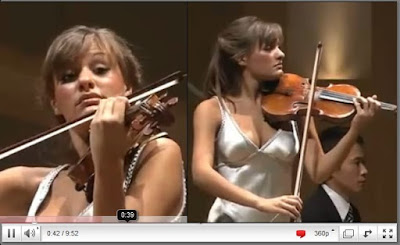
Nicola Benedetti - 'Tzigane', uma composição rapsódica do compositor francês Maurice Ravel.

Sunday, February 27, 2011

Pastoral Symphony, or "I am number six"

According to Beethoven, the Sixth Symphony is "more the expression of feeling than painting"

A classical period of chordal progression,Pastoral
afforded my mind with a kind of expression,
from apogee heights with harmonic collision,
to octaves of light under modal succession.

These were the lines in a pastoral theme,
building radiant smiles laced with idyllic beam,
whence nature and land belong to quelled dream,
and visions reveal my fresh startled esteem.